Thursday, 8 August 2013

Thursday 8th. August 2013

It was pay-back time this morning following Martin's call re. the Clouded Yellows at the weekend . I picked Martin up and arrived at High Elms shortly afterwards , and headed straight for the bottom glade which had produced most White-letter Hairstreaks on the full transect yesterday . The sun had only reached one half of the glade , but several WLHs were already breakfasting on the Canadian
Golden Rod . 8/10 specimens were found during the visit and Martin got some good video footage , but I'm sure when the glade filled with sunshine , the numbers would be even larger . We pushed on along the bottom path , arriving at the bottom of Burnt Gorse , where we started to find several
female Silver-washed Fritillaries . At the far end , we found both male and female , but she was not interested in his advances and he finally got the message and went on his way . We had a look from the gate overlooking Musk Orchid and Downe Bank , and whilst listening to the calls of a juvenile
Common Buzzard in the distance , watched a large Corvid fly over the valley , a possible Raven ? With just the 100mm. lens on the camera , it was a long distance shot . Shortly afterwards , an adult
Common Buzzard appeared and started quartering the valley bottom , no doubt hoping to shut up the juveniles plaintiff cries . After visiting the two smaller glades , we arrived at the Orchid Glade ,
which also was only in partial sunshine , but still produced another 5 WLHs , all on Hemp Agrimony , and a very fresh Red Admiral , along with the expected species . When we arrange the visit to HE , the intention was to go on to Hutchinsons Bank , and , tongue in cheek , find some freshly emerged female Clouded Yellows , to prove the theory that the males found at the weekend and since , were the offspring of the female that Martin had found on the site several weeks ago . On arrival , we made straight for the Cutting where most sightings had been made . With varying
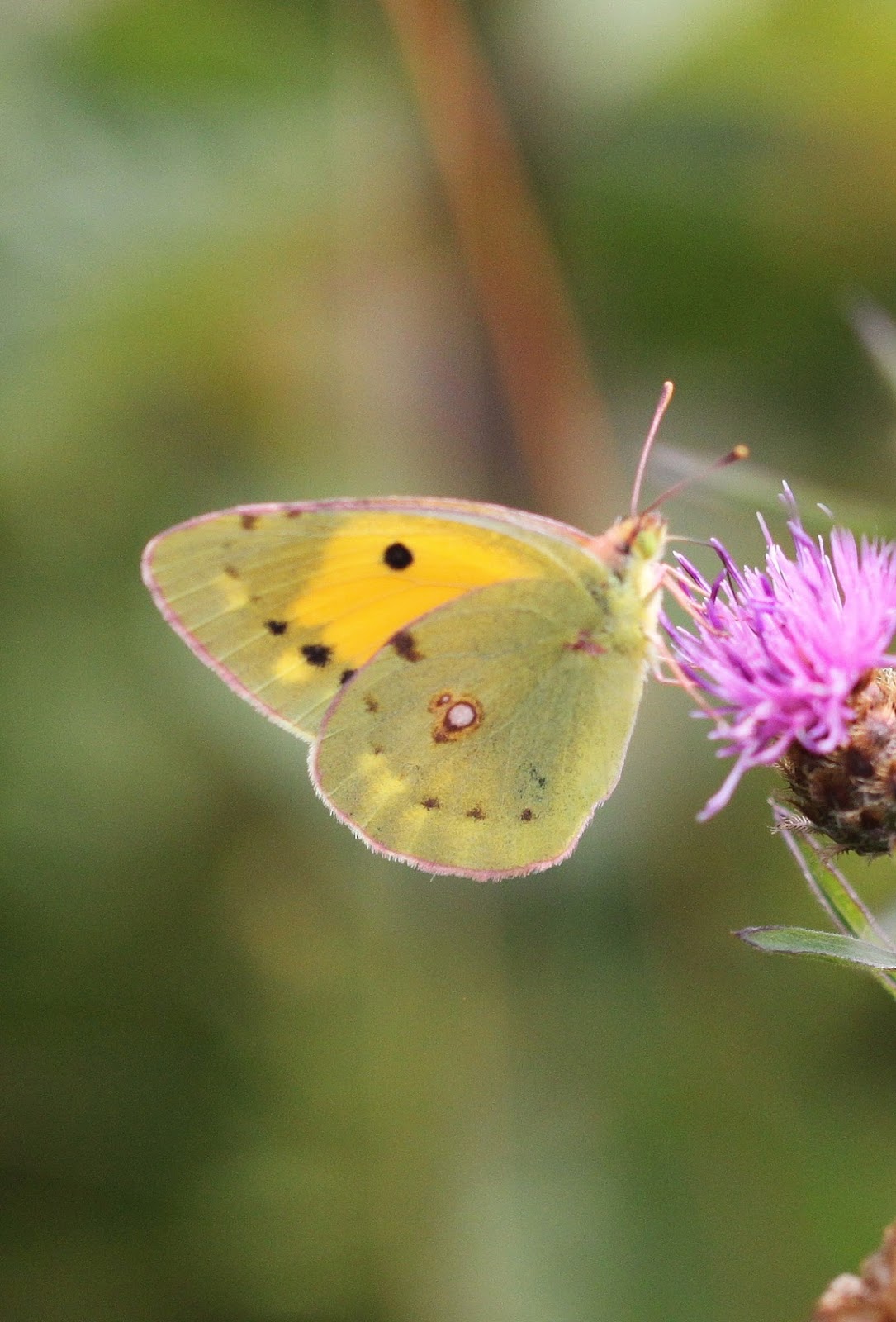
amounts of cloud cover , two active males were found during the sunny periods , this one about to
nectar on Marjoram , but with cloud cover they took up their positions on patches of open ground . But after a while , and no females seen , we decided to look higher up on the site , and it wasn't long
before the first female was spotted . Slightly larger and in the right light the lighter spots on the black border on the topwing could be seen through the underwing . The flight we noticed was also an identifying point as she was more 'flap and glide' compared to the fast , direct flight of the males . I followed this female for some time trying to get an open wing shot , and although she teased a few
times , I felt it wasn't going to be . As we watched her , she was slowly but surely heading for the steps that lead down to the Cutting and at the top of the steps we found a second female , which also seemed to be heading that way . With many stops on the way , the two females eventually did the right turn we were hoping for , and they were in the Cutting , where carried on nectaring . Within a
very short time , one of the males came bombing along the Cutting and found her . Another few
seconds and the pair had coupled . With that female busy , we turned our attention onto the other one who had reached the bend in the Cutting . She too was quietly nectaring when another male swooped
down on her , both finishing up on the ground . Another few seconds and they too were coupled , but
we had to encourage the pair to move off the ground , just in case of an accident . They were quite
happy to do so and got on with their business on a seed head of Greater Yellow Rattle . We took the opportunity to catch our breath whilst looking six weeks ahead , when the whole of the site could be flooded with the species . Martin had his video camera with him , and set it up on a tripod filming the first pair that coupled , an left it running . After a couple of minutes a third male arrived on the scene and tried to separate the pair . Martin has posted some brilliant stills from the film taken , and can be seen on his blog , a link is on my side bar . Up the far end of the Cutting , a third female appeared ,
and I spent quite some time following her , trying for some open wing shots . Before leaving the site , both very satisfied , we made one last search for any other females but didn't find any . We did however find a pristine male , second brood , Small Blue , which finished off a great day just perfectly . Can't wait for the end of September .

Wednesday, 7 August 2013

Wednesday 7th. August 2013

Yesterday morning I did the bird survey at Down House , and finished up with a paltry 13 species , the only highlight being a pair of Bullfinches . As usual , I recorded butterflies as well and almost reached the bird total with 12 species being recorded . Highlights of that survey were definitely Small
Copper (13 , all but one , very small specimens) and the same number of Large Whites , split almost

equally between males with no spots on the topwings and females with conspicuous double spots on theirs , and being second generation , the markings of both are stronger than first generation specimens . But the most interesting find was a Holly Blue , which was flying around the Sandwalk ,
eventually settling on the wet path . From it's size , I would have thought that it was a female , being larger than the male , but after a while , it flew and settled on some vegetation and opened it's wings
and the dark markings were even less than would have been expected on a male . In the large meadow I found a Painted Lady , but she didn't pose for a photograph , but in the walled
vegetable garden , I found a Peacock , warming up on the bricks of the wall . On the way round , I
found 4 of the Violet Helleborines had been browsed , probably by deer , but this one still has
managed to produce flowers even though, but the others were browsed to below the flower bud height . On the way back home , I stopped off at Hutchinsons Bank , finding just two male Clouded Yellows charging up and down the Cutting , and Terry , who was a Ranger at High Elms , who had come to get some shots of them , which he did manage to do .
After sorting some business this morning , I set off after lunch to do the High Elms full butterfly transect , arriving in sunshine , but as often happens there , cloud rolled in and quietened things down somewhat . Having said that , I did record 17 species ( 4 more than the bird survey numbers ) on the transect , and some of those in unusually high numbers ;
Speckled Wood (5) , Small Skipper (15) , Comma (8) , White-letter Hairstreak (12 - pleasingly found
in three separate areas , Conservation Field , Orchid bank and bottom glade) , Silver-washed Fritillary (14 , including two egg laying females) , Large White (51 , I thought there were good numbers at Down House yesterday , but this number was incredible) , Small Heath (1) , Small Copper (2) ,
Common Blue (10) , Brimstone (3 , one pictured) , Peacock (49 , I can only think that there has been a large hatch since my last visit , and almost all of them nectaring on Hemp Agrimony) , Brown Argus (4) , Meadow Brown (294) , Gatekeeper (91) , Small White (41 , another incredible number) ,
Green-veined White (4) and last but not least a pristine , female from the length of the abdomen ,
Painted Lady , which unlike yesterday's specimen was quite happy to pose for a few shots . Having found several species of butterfly in good numbers , I was staggered today by the numbers of Silver Y that flew up out of the grass as I walked around the site , numbers that could quite easily have challenged Meadow Brown as most numerous . I wonder if there are any left on the Continent ?
And finally , I came across two specimens of Sitochroa palealis ( thanks again Mike ) , which I
posted a few posts ago , and one of them posed nicely to show the species better .

Monday, 5 August 2013

Monday 5th. August 2013

Following yesterday's post , Warren asked if Clouded Yellows ever open their wings . In response , Marianne and Spock both confirmed that they rarely do , just when taking off or as Marianne put it so technically ' a female might when doing the bum-aloft rejection display to a male ' , I love that technicality .
So as no females were present , it had to come down to a lucky take off shot . I had a rummage through the shots I had taken , and came up with these .


I must add that there were a lot of rubbish ones too that went straight in the bin .

Sunday, 4 August 2013

Sunday 4th. August 2013

Had been out visiting and not long in , when the phone went . It was Martin who does the butterfly transect at Hutchinson's Bank , just over the border in Surrey . ' I've just had 4 Clouded Yellows on HB , are you interested ? ' , was the message . He didn't have his camera with him when he saw them , and had returned home to let people know and collect his camera . Needless to say my answer was ' Yes , I'll pick you up in 15 minutes on my way there ' . Even with picking Martin up , we arrived within 20 minutes of his call , and hastily made our way to where he had the sightings , hoping and praying that at least one was still there . Our prayers were answered with two specimens found almost immediately , and later at least five specimens were confirmed for sure , with a strong possibility of 10 specimens being seen in total .


Whilst the sun was out , they were very active , stopping to nectar for a matter of seconds before moving on , but when a blanket of white cloud moved in , they disappeared . A search found some just resting on low vegetation , but others were found lying almost prone on bare soil , no doubt to get the maximum warmth from the hidden sun .
 
 
As can be seen , I didn't manage to get an open wing shot , but given the strong wind on this open site , any shots were gratefully received . Before we left the site , we walked over an area where migrant Clouded Yellows had been seen in the past , but failed to find any . The conclusion we came to was that the specimens we were watching were the offspring of the female that Martin found and photographed , the open wing shots that I posted with his permission , some six weeks or so ago . All the specimens seen were males , but we intend to go back later in the week , in the hope that some females might have emerged by then . Hopefully on the same day I can return the favour , taking Martin to HE to see the WLHs .

Saturday, 3 August 2013

Saturday 3rd. August 2013

Taking a chance , I arrived in the bottom glade at High Elms with dark clouds still rolling through , but the chance paid off , as the skies broke and lengthy sunny spells broke up those clouds . Once again , the Canadian Golden Rod was the main search area , and within a few minutes , four White-letter Hairstreaks were found nectaring . With many dog walkers still around , an unexpected person amongst the vegetation caused concern amongst the dogs , which didn't help keeping the WLHs on their nectar plant , often flying off into the trees at the barking of the dogs . Eventually things started to quiet down , and the butterflies began to become more confident . By the time one of the Keiths rang , he had seen my car in the car park , numbers were increasing , but he was beaten to the site by
the other Keith who had come in from the opposite direction . The females still looked in perfect
condition  , but the males have obviously had a bit of pushing and shoving , reflected in then looking less tidy due to losing scales from their wings . As mentioned before the tails of the female are
noticeably longer than those of the male as can be seen from this shot and also the size difference , with the female on the left . The CGR also attracted other insects drawn to it's scent , like this
Longhorn Beetle / Strangalia maculate . Silver-washed Fritillaries were not as numerous in the glade as on my last visit , but those that were there seemed much more laid back and totally unconcerned
about a lens in close proximity . I don't know if it was the intoxication of the nectar or the flavour of his chewing gum , but one of the Keiths managed to get both SWF and Comma to settle on his finger . As the temperature rose , more species came on the wing , including a couple of very freshly
emerged Peacocks , one pictured . Although there was plenty of nectar to go round , it appeared that
some Hemp Agrimony flowers tasted better than others , when the heads were shared , like this SWF
and Comma , and a bit later , a SWF and a female Meadow Brown . By the time I left the glade , WLH numbers had reached 7 , and with the one Keith had found on the Orchid Bank on the way from the car park . things were looking good . On my way back to the car , I re-found the one on the Orchid Bank , and checking the two small glades on the way , finding one female SWF egg laying in
one and two in the other , things are looking good for that species too , with their numbers remaining about 15/20 . A phone call from Keith later in the afternoon letting me know that the WLH numbers had increased to 12/14 before they left the bottom glade was music to my ears . He also found a male Brown Argus on Burnt Gorse , lets hope that will be the first of many as that species had a very poor first brood on site .

Friday, 2 August 2013

Friday 2nd. August 2013

Firstly , many thanks to Spock for correcting my moth identification from the last post . I did feel confident with Dot Moth , but it turns out to be a close relative , the Cabbage Moth .
I spent yesterday , the hottest day of the year , on the North Kent Marshes at Cliffe , searching for two species of Odonata that have turned up again this year , Scarce Emerald and Southern Emerald . I had hoped that the wind would have dropped some from recent days , but on the flat marshes , with barely anything to act as a windbreak , it was still blowing strongly , with occasional stronger gusts . Given that both are small damselflies that are found amongst the emergent vegetation in the drainage ditches , that wind was the last thing I wanted . The Scarce Emerald was reasonably easy to find , but , given the wind and the temperature , which made them extremely active , getting any shots was obviously going to be difficult , adding the large number of Blue-tailed Damselflies into the equation made things even harder , as all the damselflies seemed in a very argumentative mood giving rise to
continual aerial battles . Patience , and a lot of dumped shots , eventually brought a few results , all specimens found being males . The species is identified mainly by the pruinescence , bluish colouration , covering only half of segment 2 , the same on the Emerald Damselfly covers all of that segment . The Southern Emerald is easier to identify , but harder to find because they are fewer in
number . Once again , only males were found , but at least he was closer and in a more sheltered spot . Common Darters were everywhere , closely followed by their relation , Ruddy Darter . The
male a vivid crimson , and the female , colour-wise , very similar to the Common , but both with
completely black legs , the best way to separate the two species . Some wanted to be photographed
with their mate , whilst they got on with more important business . Other species seen included Emperor , Southern Hawker , Brown Hawker , Black-tailed Skimmer  , a very mature Four-spotted
Chaser (pictured) and the large number of Blue-tailed Damselflies already mentioned .  Speaking of which , a couple of interesting forms were seen during the visit . The first was the form rufescens-
obsoleta , a female that would firstly been of the form rufescens , before becoming this yellowish-brown colouration . A terrible shot , but she was being thrown all over the place by that wind , and
what looks like two males on the right of the stem , but the lower specimen is the female form andromorph , which would have started out as a form violacea , with a violet thorax . Needless to
say , there was no shortage of Marsh Frogs all over the site .