Monday, 6 May 2013

Monday 6th. May 2013

Don't usually venture out on Bank Holidays , but early sunshine got the better of me and I headed for High Elms LNR , in another quest for an early Skipper . Just joggers and dog walkers on the way , but arriving at Burnt Gorse , I had the site to myself . There followed a lot of effort up and down the slope , with very little in return . Each time I reached the bottom , I had a look at the stand of Garlic Mustard , but just one male Orange Tip was seen . On one search up the slope , my hopes were raised
briefly , but it turned out to be a moth , Garden Carpet I think , but don't take my word for it . About an hour in , and just about as far as it is possible to go on the site , a speedy movement that was very
difficult to follow , turned out to be what I was looking for , a Grizzled Skipper . A tiny butterfly , smaller than a Small Skipper and much harder to find , and even much harder to follow once found . I carried on searching for it's relative the Dingy Skipper , but that one eluded me today . The other species on my possible list was the Green Hairstreak , and on one of the later climbs to the top of the
slope , I finally found one , quickly followed by a second , not on their favoured Wayfarer bushes ,
but on the ground vegetation . Like other butterfly species , the males emerge first , and this was proved when the two met , and immediately started scrapping . In total , 9 species were recorded ,
including another Holly Blue , but still am looking for my first Speckled Wood , which would have got me into double figures . A couple of other insects found whilst searching were the ridiculously
long legged Beefly - Bombylius major , feeding whilst still beating it's wings like mad , and the
colourful Sloe Shieldbug - Dolycoris baccarum . A few plants found pushing through and starting to flower included :
Common Twayblade - Listera ovate , a not very colourful member of the Orchid family ,
Bugle - Ajuga reptans , a member of the square stemmed Labiate family ,
Yellow Archangle - Lamiastrum galeobdolon of the same family ,

and Wood Sorrel - Oxalis acetosella , with it's delicate streaked flower petals , and Clover like leaves .
Still no sign of House Martins at their usual site , but I did see one Grey Wagtail in the yard , so hopefully they will nest there again this year .

Sunday, 5 May 2013

Sunday 5th.May 2013

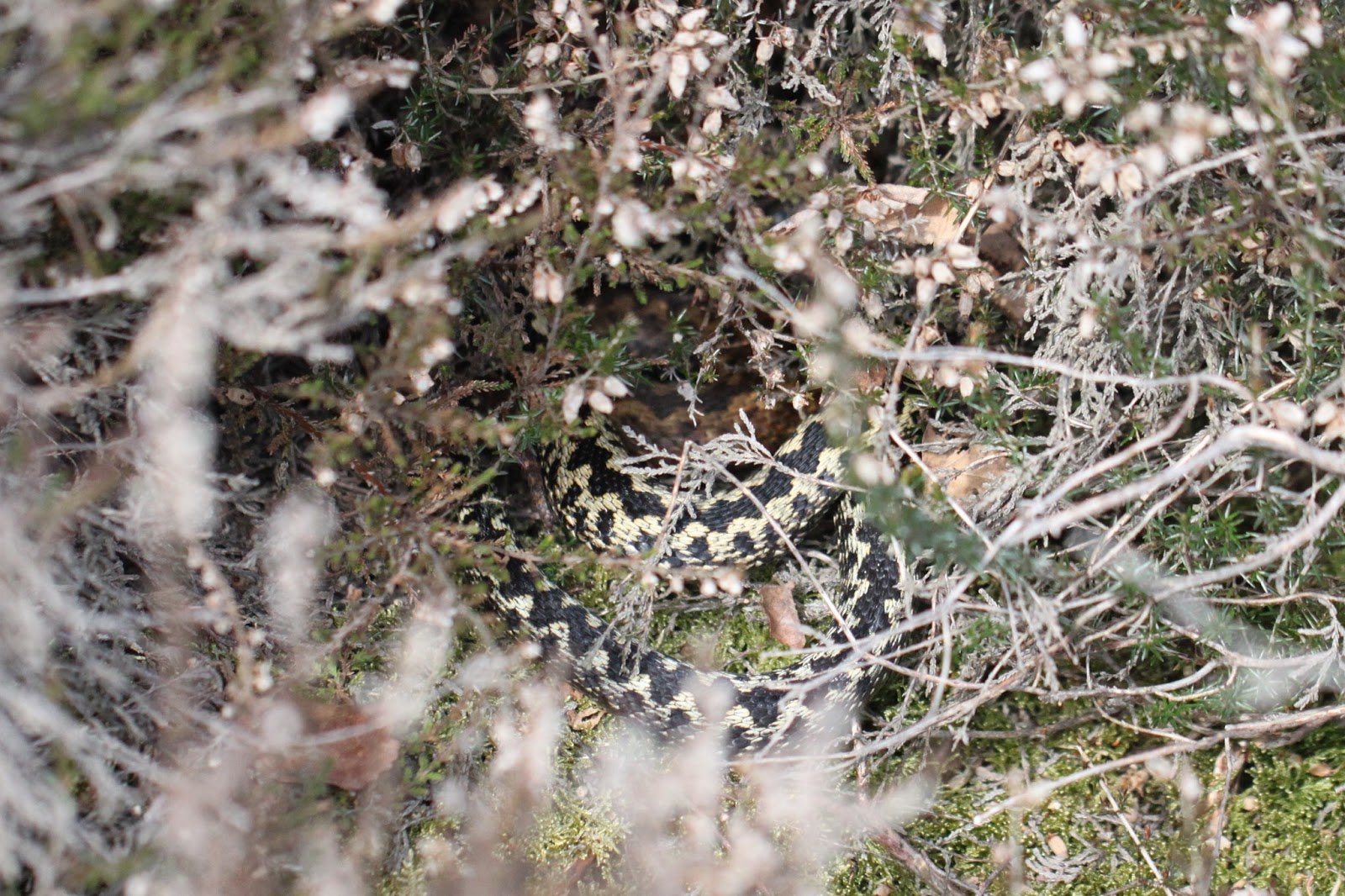
Took Carol to do the monthly shop early yesterday , in the hope that things would brighten up later , but that didn't happen , as towards lunchtime those clouds were thicker and producing odd spots of rain . Even so , a glimmer of brightness after lunch had me itching to get out , so off I set for the Greensand Ridge , in anything but reptile conditions . No sign of the pair that I had seen mating a couple of days ago , in fact very little indeed . I searched other areas that had held animals recently , but they too didn't produce . I must admit at one point I thought to myself , what am I doing here in just a tee shirt and a gillet in a cool breeze . Eventually the clouds did break up a bit , but it didn't affect sightings .
That was until I spotted this silverback male , in a very alert pose , his tongue constantly flicking in
and out , and I knew it wasn't me he was scenting as I was downwind of his position . He moved off at speed , moving effortlessly and silently through the heather and gorse . As he would disappear for a short time then re-appear a few metres away , I wasn't sure if there was just the one or two animals . I must have watched him / them for about 20 minutes , but nothing else seemed to be happening . I decided to leave it / them to it , as I was getting chilly standing about . As I went to move , I caught a movement on the edge of some heather , and with binoculars could see that it was a female , half in ,
half out of the vegetation . Now , this explained the way the male / males were acting , so I decided to hang about for a while longer , but moved a short distance away to see if I could refind them . A couple of fleeting glances was all I got , so went back to the female , to find not just her , but , jerkily
moving all over her body were , as I had suspected , two males . The female moved back into cover ,
and I could make out the 'carousel' routine starting , same as a couple of days ago . After a short
time , one male baled out of the 'carousel' onto the mossy area in front , and seemed to be watching
the other two . The male still with the female seemed to resent a 'voyeur' and he too baled out of the
'carousel' and headed straight at the other male , which needless to say started a fight . A bit timid to
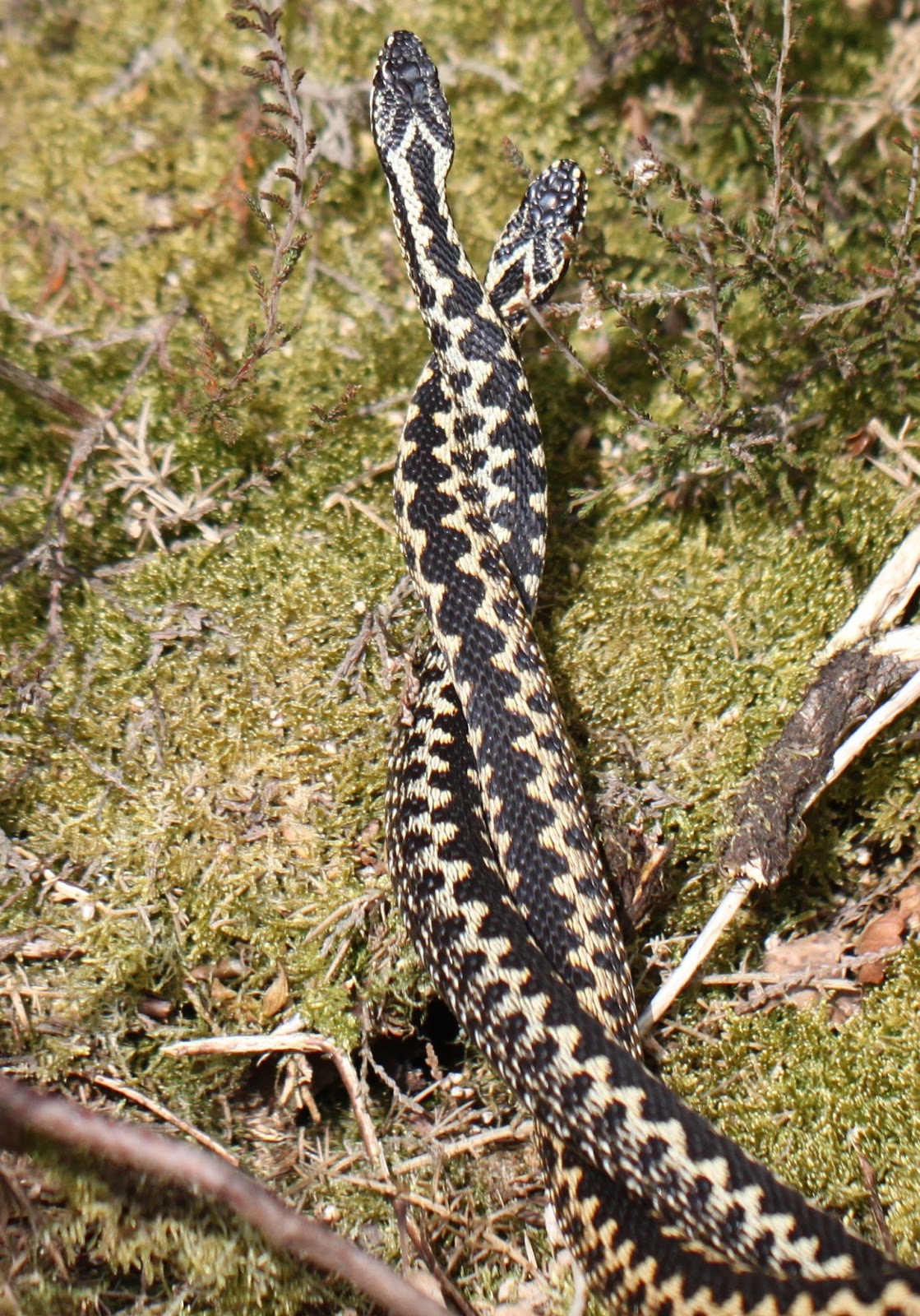
begin with , with both animals crashing horizontally through the heather . Very soon it developed into a proper 'Dance of the Adders' , as each animal tried to outreach and push down on the other . It was
now that I noticed a slight colour difference between them , one with clean white base colour , and the other with more of an off-white base colour . The battle went on for a good half hour looking back at the times on the camera , but it seemed like just five minutes , when the white animal turned away and disappeared into the heather . With that , the off-white animal made it's way to a large open
mossy area , and you could almost see it collapse under the efforts of the previous half hour . It
remained motionless , until , from the nearby heather , came the cause of the action , the female .
She moved down slowly and he moved over to join her , and they settled down together . There they remained for a good 5 minutes , and I started to think about heading home , as all the action was
finished , when back in comes the white male , and the two males started all over again , firstly in the mossy area , often crashing down onto the female . But she soon had enough of that , and she slipped
off back into the vegetation , and left the two combatants to it . It was at this point that 'Card full' came up on the camera display , and I also noticed that the battery warning was flashing too . I must
admit I found it rather difficult to change the battery and the card , whilst trying to watch the pair . With the camera sorted it was back to the fray with the pair trying to best each other on who was
tallest , before crashing back down into the heather , before starting all over again . Sometimes , they fought out in the open , which I must admit made focusing much easier than when they were
thrashing through the heather . At other times they were heading straight towards me , and although I
was never more than 3/4 metres away from the battle , neither took a blind bit of me , there was a bigger prize at stake . I just couldn't believe the effort and commitment that both animals put into the
battle was immense , with very few moments to draw breath , never mind rest . Eventually , the white animal left the arena , and again the off-white animal again collapsed with fatigue . I watched him for a while , motionless , then , the tongue started flicking again , and again the white animal came back
for more . But both were now 'running on fumes' and this final action lasted just a few minutes , before once again , the white animal retreated , this time closely pursued by the off-white one . A couple of minutes later , the off-white 'victor' returned and very slowly made it's way deep into the heather , where no doubt tis 'prize' was waiting for him . Looking back on the time on the camera , from first sighting of the silverback to the time when his tail disappeared into the heather , an amazing 1 hour and 53 minutes had passed , I couldn't believe it , but when I got home and found that I had 542 photos to download , I did believe it . Looking through some of the shots taken , I was surprised that although setting a shutter speed of 1/4000th. of a second , there will be many heading for the recycle bin . This is the 6th. or 7th. time I have been privileged to witness the 'Dance of the Adders' ,  I hope it will not be my last .
I emailed a couple of fellow enthusiasts last night about the 'Dance' , and was quite expecting to see 1 or 2 on site when I went back this morning , in better weather than yesterday . No sign of anyone when I arrived and no sign of the 'couple' . It was only going to be a quick look and back home , when David , one of those I emailed turned up . We had another look around , and David spotted a silverback some 7/8 metres from the combat area . It moved off soon after sighting , but we managed to track it back to where the female was yesterday afternoon . The I spotted the female , tucked well down in some gorse . The animal that David found , which was probably the white animal from the combat , scoured the area until he found the female and made his way to her , only to find that she was already coupled to the off-white animal , and he was staying where he was , no more combat .
The white animal made several visits to the pair , but seemed eventually to realise that he was the
vanquished and with his proverbial 'tail between his legs' , left the pair in peace , and that was exactly what we did , with the hope of seeing their offspring in the Autumn .

Saturday, 4 May 2013

Saturday 4th. May 2013

A very quick catch up on yesterday afternoon , when I went back to Burnt Gorse , High Elms LNR , to try again for an early Skipper or Hairstreak .
A female Kestrel , sitting above the car park as I arrived .
A walk along the lane produced the dainty Goldilocks Buttercup - Ranunculus auricomus ,
together with another member of the Buttercup family , Green Hellebore - Helleborus foetidus .
The track from Cuckoo Lodge to Burnt Gorse provided promise of White-letter Hairstreaks later in the season , with Wych Elm -Ulmus glabra , the butterfly's foodplant , beginning to flower .
Burnt Gorse failed again for the target species , in fact just one Orange Tip and one Brimstone were seen . So I decided to sit down next to a large patch of Garlic Mustard - Alliaria petiolata , in a coppiced area below Burnt Gorse , to try and photograph a female Orange Tip .
A small number of males continually visited the flowers , searching for a mate , and when failing , refuelled before moving off again .
Eventually a single female flew in to feed , and from nowhere , two males appeared , obviously more interested in mating than feeding . But they did not get their way , the upward pointing abdomen of the female once again thwarting their advances , and eventually flying off again . Whilst waiting , I also searched the plants for the green , becoming orange eggs of the Orange Tip , but didn't find any . No other females came to the site whilst I was there .
On the way back to the car , I found just two specimens of a plant I have been searching for over many weeks . Just about 4 cms. tall , so very easily overlooked , Moschatel - Adoxa moschatellina , with the wonderful common name of Town Hall Clock .
It gets that name from the four green flowers at right angles to each other , like on a Town Hall clock , with a fifth on the top . The tiny flowers are only about 0.5 cms. across .
Another catch up tomorrow from today , but I think it will be worth waiting for .

Thursday, 2 May 2013

Thursday 2nd. May 2013

With some more good weather promised , I set off early for the Greensand Ridge , arriving on site at 0745 , with frost still on the ground . I worked out a circuit , and decided to keep doing laps to see when animals came out to warm up , and the walking would keep me warmer too . Nothing seen on
the first lap and just one 'silverback' male seen on the second , half an hour later . Males change to this 'silverback' colouration when a female who is ready to mate , just every other year , is scented in the area . On my third lap he was still there and a second animal found some distance away , which to
me was a definite male too , with zig-zag markings as black as the 'silverback' . On my fourth lap , just after 0900 , the 'silverback' had already retreated into shade behind his original position . when I got back to the brown and black 'male' , I found it cosied up with a smaller 'silverback' and things were getting even hotter than the sunshine . The 'silverback' was doing a lot of tongue flicking and moving over the other animal , then both disappeared out of view . I continued the lap , finding a few more animals , including a couple more 'silverbacks' . When I got back on lap 5 to where the pair had disappeared from previously , they had reappeared , and it was obvious that mating was just beginning . The reproductive organs of snakes are found towards the end of the tail , and the two
were writhing about , trying to couple , which they did . There followed a weird performance that I can only describe as a carousel ride with both animals swirling around whilst united . Trouble was , with the female being the larger of the two , she dictated the momentum , and soon the male couldn't keep up with her . Soon , still coupled , she was doing the carousel thing frontwards , and the male was being dragged around , backwards . Funny to see him pass tail first , and finishing up with his head , but probably not for him . The time spent there on this lap was about 50 minutes and in total from when I first saw the pair was 1 hour fifteen minutes . I should imagine the male was quite relieved when they uncoupled , he shot off like a rocket , she curled up deep in the vegetation . As the day continued to warm up , no more new animals were found and those that were out warming up , headed for the shade and out of sight . Whilst on site , I also found three sloughs , the cast off skins of
 the animals . With things gone quiet , I headed home for some lunch .
After which I headed up onto the Common , to see if I could manage what I failed to do yesterday , photograph a Brimstone laying an egg . On the way I looked in on the juvenile Common Buzzard , and it was sunning itself on it's favoured post , thinking aloud , it will soon be it's first birthday .
Several Brimstones were found on the Common , but all males , charging around . I sat on a log in an area of Buckthorn , hoping for a female to arrive . One didn't , but a flash of blue produced my first

Holly Blue of the year , a male , identified by the small amount of dark markings on the forewings .
With no sign of any female Brimstones , I moved to another area of Buckthorn , and after a few minutes one obliged , but would insist on laying behind leaves and twigs . Eventually an opportunity
presented itself . After laying several more eggs , she flew down to the ground to rest , only to be
found by a male , with a single agenda on it's mind . He forced her down to the ground , but with her abdomen held high , there was no way that he was going to be able to enforce his agenda .  He
wouldn't take no for an answer though , as he chased her again into a spiralling flight high over the trees . No sign of the 2/3 Common Buzzards seen recently , but a single Kestrel and two Sparrowhawks were seen hunting .

Wednesday, 1 May 2013

Wednesday 1st. May 2013

First job this morning was the bird survey at Down House . It was chilly to start , but warmed up somewhat during the survey , which was more than could be said for the survey itself . An average count of 21 species , produced nothing special , with just two migrants recorded , two singing
Blackcaps , which could have been over-wintering birds . Three Song Thrushes , this one on one of the formal lawns and a flyover Common Buzzard were about the best of the list . In the Sandwalk
woodland , the parasitic Toothwort - Lathraea squamaria , a member of the Broomrape family , looks as if it is going to have a good year . A look in on the Common on the way home , found the LTTit nest intact , especially after hearing from John that the one we had watched being built on the small reserve has been predated . I almost managed to photograph a female Brimstone egg laying , but she
flew just as I got to the Buckthorn that she was laying on , but her freshly laid egg was attached to the fresh new leaves , a first meal for the caterpillar when it emerges . The female only flew a short
distance before resting , then flew off to continue her laying . After lunch , I headed for High Elms LNR , to do the first full butterfly transect of the year . Once again , recording was very slow , but it was warmer now . Just 25 butterflies were recorded over the 2 hour transect , from just 6 species . Peacock (10) topped the list , with Brimstone (7) , Orange Tip (4) , Comma (2) and singles of
Green-veined and Small White bringing up the rear . I had hoped to find one of the early Skippers ,
Dingy or Grizzled , or even a Green Hairstreak , but it wasn't to be . Whilst on Burnt Gorse , I met up with fellow enthusiast Keith , also hoping for the same species that I was looking for , but at least it gave a chance to catch up , good to see you again Keith . Only other interest found was a small group
of Coltsfoot -Tussilago farara , a member of the Daisy family , much already gone to seed , along the bridle path , I don't remember seeing it in that spot before .